

The Hindu gotra system is one of the most ancient and oldest genealogical classification systems in the world, as it dates back over 3,000 years ago with the great Vedic Rishis (sages). If you’re planning to marry someone from a Hindu heritage or exploring your ancestral heritage, or just want to know more about it, you need to be familiar with the term “gotra.
This complete reference article will provide information about the Hindu Gotra System, including:
- Scientific Explanation of the Gotra System
- A List of All 49 Recognized Gotras Gotra
- Matching for Marriage: The Pravara System and Its Function
- The Various Regional Differences in India
- The Modern DNA Validation of Ancient Knowledge
The authoritative answers to the questions listed below have been determined through Vedic texts and scientific research on genetics, and these topics will be further explained in this guide: the rules governing marriage within the same Gotra, and the distinction between Gotra and Pravara.
Gotra: Definition
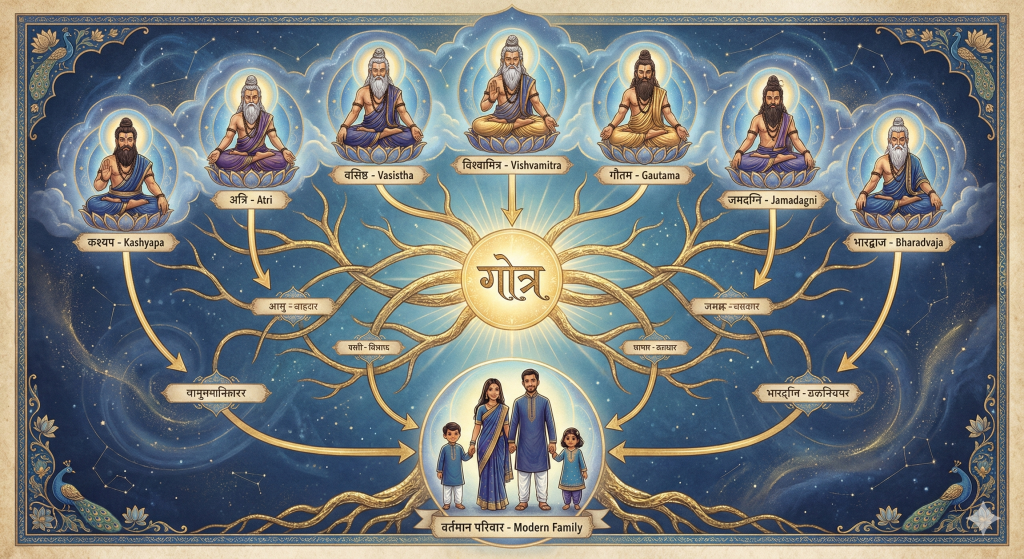
The term “Gotra” is derived from the Sanskrit term” Gotr”, which means “Cow-Pen.” The term ”Gotra” has an inherent significance. In Hindu tradition, Gotras are understood to be a means of tracing and identifying, through male descendants (father to son), one’s paternal (father’s) lineage. Thus, “Gotras” signify that you (the reader) can trace your ancestry (paternal) through a paternal (male) line back to your Rishis (the founders of each of the original Hindu Gotras).
Saying “I belong to Bharadwaja gotra” indicates that you can trace your line and heritage back (through an unbroken male line) at least 100-150 generations back (over 2500 years).
The gotra system originated from eight major Rishis (sages):
Vishvāmitra, Jamadagni, Bharadevaja, Gautama, Atri, Vasishtha, Kashyapa, and Agastya are the eight Rishis that established the gotra system as it’s known today.
The children of these eight Rishis (sages) would all be declared by Rishi Baudhāyana, the first enshriner of the gotra system, to be members of a particular gotra.
The following eight Rishis are examples of authors or cultural contributors included in Sanskrit literature:
- The Gautama Dharma Sutra by Gautama
- The father of Dronacharya (featured in the Mahabharata) Bharadwaja
- author of the Gayatri Mantra Vishwamitra
- Royal priest of Lord Rama’s lineage and purported father of all creatures Kashyapa
- Dattatreya’s father Atri
- father of Parashurama Jamadagni and Agastya who is credited with bringing Vedic culture to southern India.
Reasons for the importance of Gotra in today’s society: Knowing your Gotra is important for:
- ✅ Marital compatibility – Avoiding marriage with a person from the same gotra
- ✅ Performance of Vedic rituals – Required for performing Sankalpa (Ritual Declarations)
- ✅ Connection to cultural heritage – A way to connect back to Cultural Roots
- ✅ Genetic Health – To avoid marrying one’s blood relative scientifically
- ✅ Networking within a community – Associating with others who share the same Gotra and supporting each other in many different ways
Study of the interaction between genetics and gotra as affected by inheritance via the Y chromosome by combining scientific methodology with centuries of experience of the same in traditional cultures.
Genetic history and gotra as affected via Y chromosome inheritance.
The main focus of my research is to show how gotra can be connected to genetic ancestry in mankind through the analysis of Y-DNA to establish the paternal line of males in families. The Y-DNA of a paternal ancestry line can be traced from son to father through multiple generations by use of Y-DNA.

Important Scientific Information:
A father’s Y chromosome is transmitted to his son without modification It contains between 50 to 200 genes within the non-recombinant portion of the Y chromosome. Y chromosome mutation rates are extremely low, approximately 1 per million years for every 1,000 bases. Identifiable lineages have existed for many thousands of years via the Y chromosome
1898 findings in the journal “Scientific American” regarding research relating to DNA evidence as it pertains to the case of Thomas Jefferson and Sally Hemings
The findings showed how powerful and consistent chromosomes are over the course of human history. For example,
The question at hand was whether or not Thomas Jefferson was the biological father of a child by a Black enslaved woman. [Sally Hemings].
The method employed was to contrast one set of Y-chromosomes belonging to Jefferson’s grandfather (who was a paternal uncle of Thomas Jefferson) & Jefferson’s grandfather’s descendants about eight generations later with another set of Y-chromosomes from the son of Hemings’ son (Thomas Hemings), whose descendants were five generations later.
The outcome revealed that, after two centuries, the chromosome of both groups continued to be the same; thereby providing evidence that one can trace an individual’s gotra through up to 100 generations or longer.
Gotra System: Summary
The gotra system, which has historically recorded the lineage or family tree of a male line up to the Y-chromosome identification (which remains identifiable in generations 8 and 200 years back), has been documented on the theory that this lineage can be identified for 100+ generations (300 AD), and is scientifically valid.
Genetic Advantages for Gotra Exogamy
The restrictions on marriage of the same-gotra give rise to clear genetic advantages:
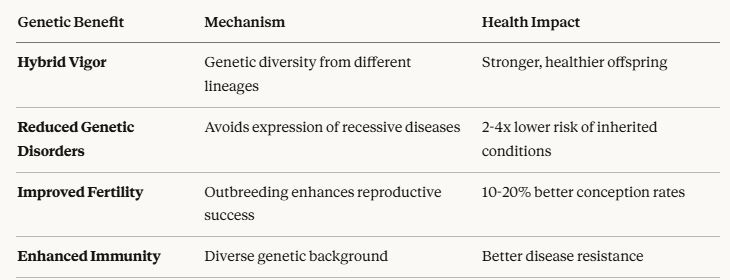
Key point: Ancient sages (Rishis) observed and used their extensive knowledge to establish a methodology for the health of the population that is now confirmed, through modern genetics, to be scientifically sound.
A Full List of 49 Gotras with Pravara
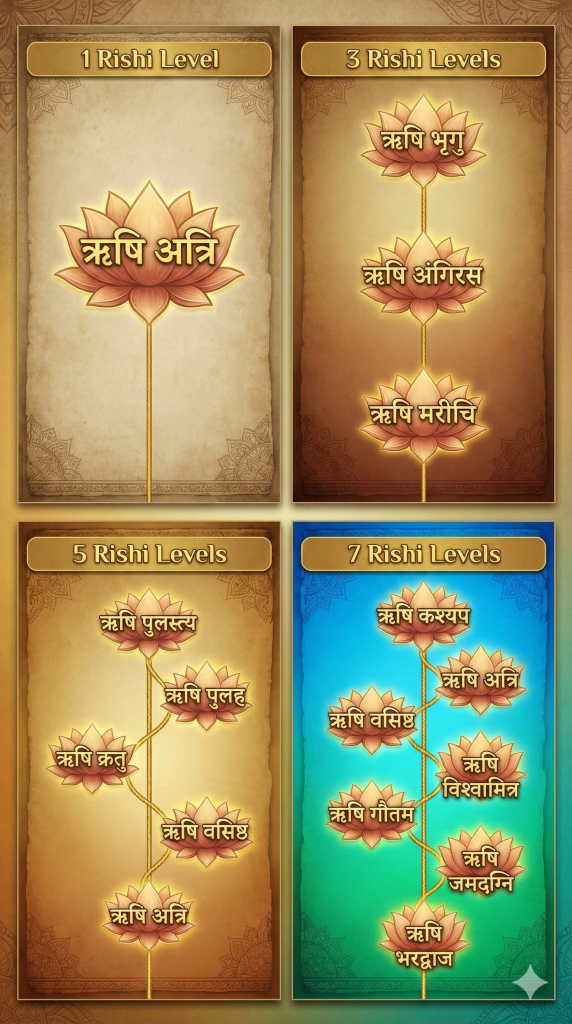
Defining Pravara
Before getting into the details of a full list of gotras, let’s first define pravara:
The term “Pravara” can be translated as “most excellent,” indicating the quality of your Pravar(s) with respect to their respective lineage. Pravar refers to the “Rishis” of your gotra and specifically to the lineage from which you came.
There are five types of Pravar:
- Ek-Rishi (one Rishi) – rare
- Dwi-Rishi (two Rishis) – uncommon
- Tri-Rishi (three Rishis) – most common, (~80%)
- Pancha-Rishi (five Rishis) – rare
- Saptha-Rishi (seven Rishis) – very rare
Bhrigu Lineage Gotras (20 Sub-Gotras)
Founding Sage: Bhrigu Maharishi (one of Brahma’s Prajapatis)
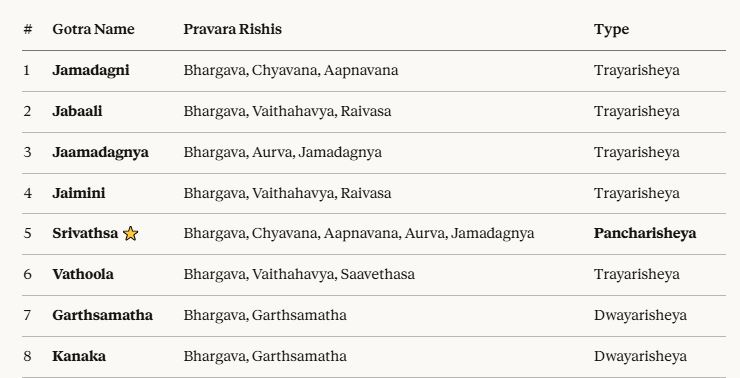
* Note that Srivatsa (the 5th Rishi of five) has the only Name Gotra in the Bhrigus that is currently existing, which makes it the most rare type of gotra in the world. This gotra is predominantly found in many parts of southern India.
Origin: Aangirasa
Gotra Classification: 27 sub-gotras
Founder: Angirasa (Manasa Putra of Brahma)
Comments: The largest line in all gotras with the highest number of Atharvavedic hymns.
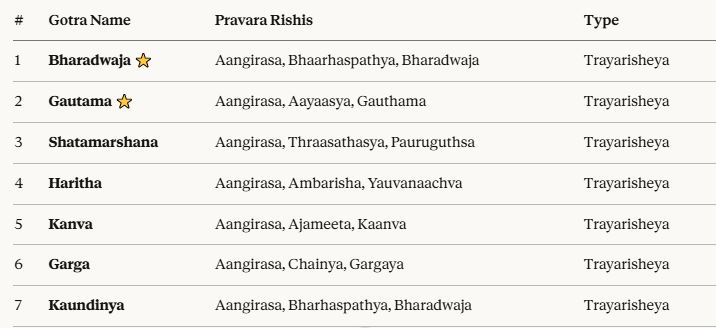
Note: Common Gotras: Bharadwaja and Gautama are prevalent gotras all across India.
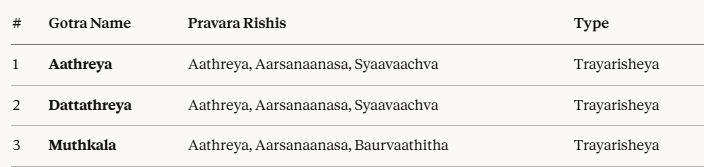
The Atri Lineage has 13 Sub-Gotras.
Atri Maharishi was the Founding Sage of the Atri Lineage Gotra, which is associated with the worship of Moon / (Soma).
There are 13 Sub Gotras of the Gotras of the Vishwamitra Lineage.
These 13 sub-gotras are from the same progenitor(Sage Vishwamitra) or from the same Original name (King Kausika), who was a kshatriya / a king when he became a Brahmarishi. The most significant contribution by sage Vishwamitra to the spiritual community was that he created the Gayatri Mantra.
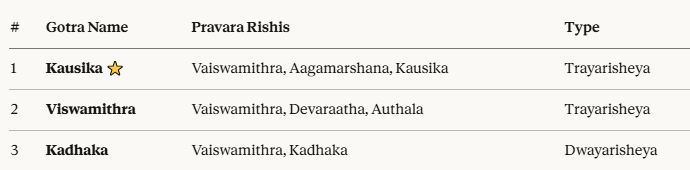
Note: The 11 clans of royal Marathas have significant historical relevance. Several of these clans, and Shivaji Maharaj’s clan, fall into the Kaushik gotra.
The Vasishta Lineage has 13 sub-gotras and was founded by Vasishta Maharishi.
Vasishta Maharishi is the Rajpurohit of the Solar Dynasty and is known for his Ekarisheya (Single Rishi) Pravara (lineage).
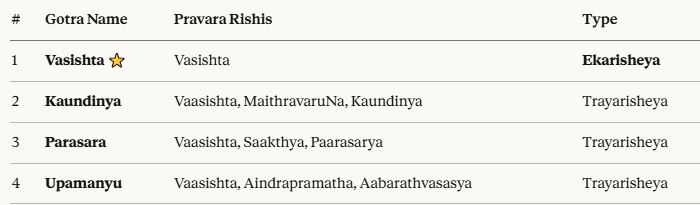
Note: Vasishta gotras are notable for their unique feature of having the only single-rishi pravara.
Kashyapa is a name that contains 13 separate gotras founded by the sage Kashyapa Maharishi.
All things were created by Kashyapa Maharishi. He has both a Trayariseiya and a Saptarisiya version of his gotra.
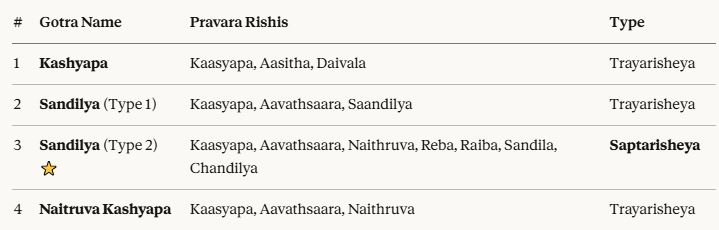
Note: There are three variations of the Sandilya Gotra Pravara (the name of the ancestor/s and family lineage). Each of these variations should be considered for the Marriage Compatibility assessment.
The Agastya Lineage has Seven Sub-gotras
Agastya Maharishi began the Agastya lineage and contributed significantly to the development of the Vedic culture in South India, particularly Tamil Nadu and Kerala.
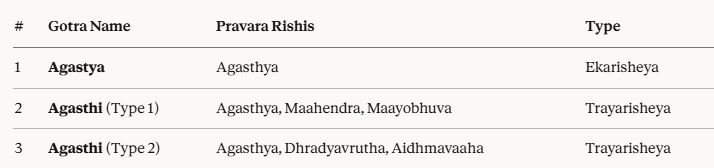
Gotra Matching: How To Learn About Gotra Matching, Reasons Why Inter-Gotra Marriages Are Opposed
Hindu Marriage is Based on the principle of Sagotra Vivah Nishedh (सगोत्र विवाह निषेध), which means that same gotra marriages are prohibited.

3 Different Restrictions on the Level of Marital Relationship
1st Level:
Primary Gotra Restriction/Prohibition (mandatory rule)Bride’s gotra must be different from the groom’s gotraExample:
❌not allowed: Groom’s gotra (Bharadwaja) + Bride’s gotra (Bharadwaja)
✅ allowed: Groom’s gotra (Bharadwaja) + Bride’s gotra (Kashyapa)Rationale: If both partners are in the same gotra, their children would have an increased probability of being born with genetic defects due to their patrilineal ancestry.
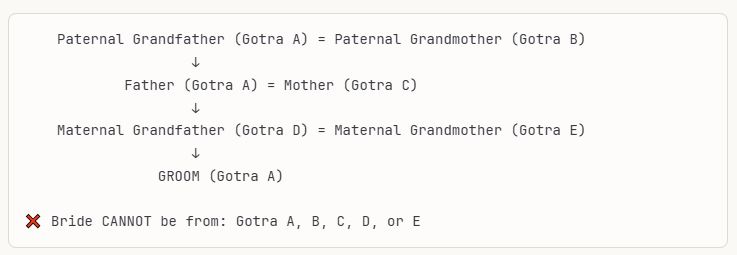
Level Two – Extended Gotra Prohibition (Traditional)
Rule: The Bride Must Not Be From The Following 4 categories of Gotras: –
- The same gotra that the Groom belongs to
- The Mother of the Groom’s gotra
- The Paternal Grandmother of the Groom’s gotra
- The Maternal Grandmother of the Groom’s gotra
Prohibited Gotras Diagram:
Regional Variation:
- In Northern India, there is a four to six-gotra prohibition, which is highly restrictive.
- In Southern India, there is a three-to-four-gotra prohibition, which is moderately restrictive.
- In Urban or NRI areas, there is generally a two to three-gotra prohibition, which is the least restrictive.
Level 3: Pravara Matching Rules (Advanced)
Important Distinction: The type of pravara greatly impacts marriage rules. When it comes to putra-parampra (father-son) direct lineage, the restrictions are very strict: Any pravara connection (matching Rishi) prohibits a marriage and is therefore NOT acceptable.
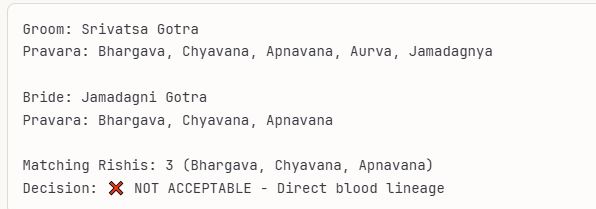
FLEXIBLE RULE- NON-MARRIAGE IF MATCHES ≥50% OF RISHIS
- Example – ACCEPTABLE
- Groom = 3 Rishis; Bharadwaja Gotra = Bharadwaja, Bhaarhaspathya & Aangirasa
- Bride = 3 Rishis; Gautama Gotra = Gautama, Aayaasya & Aangirasa
- Rishi matches = 1 (Aangirasa); Match percentage = 1/3 = 33.3% ; Decision = ACCEPTABLE; matches < 50%
Calculation Table:
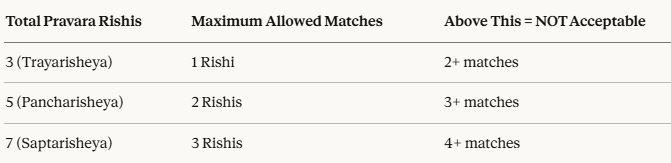
Sequence of actions to assess compatibility for Marriage
1. Collect all the above data for both individuals (Bride and Groom ) , including :
- Full name of Gotra
- Complete Pravaras, which includes all the names of Rishis
- Total number of Pravaras
- Mother’s gotra of both individuals
- Grandmother’s Gotra of both individuals
Step 2: Primary Gotra Verification
As soon as the bride’s Gotra is compared to the groom’s Gotra, if they match, then STOP – this union is NOT permitted as per custom. Otherwise, please move to Step 3.
Step 3: Extended Family Gotra Verification
If the bride’s Gotra matches ANY of the following:
- The Groom’s Mother’s Gotra
- The Groom’s Paternal Grandmother’s Gotra
- The Groom’s Maternal Grandmother’s Gotra
then this union is NOT permitted as per custom. If the bride’s Gotra does NOT match any of these, then you should move to Step 4.
Fourth Step in Selecting a Lineage
Asking ELDERS OR WOOD OF LIFE = IS THIS THE TRADITION OF PUTRA’S, OR IS THERE ANY TEACHER WITHIN THEM?
When in Doubt, It will always be treated as a safer method. Fifth Step Matching Analysis
If you come across a Putra, count how many RISHIS matches you may find
If there are, this is a Strong Negative. If you find nothing, this would be Strongly Accepted, OR A POSITIVE.
Matching Rishis/Bharadwaja Family’s Prabhu (3)
Step 6: Final Confirmation. ✓ Family Elders, ✓ Family Purohit, ✓ Family Community Leaders/Organisation, ✓ Family Community Scholars (If Case is Complex).
Examples of Real Marital Compatibility: Example 1 (COMPLETELY ACCEPTABLE) Groom’s Information:
- Name: Rajesh Sharma
- Gotra: Bharadwaja
- Pravara: Aangirasa, Bhaarhaspathya, Bharadwaja (3 Rishis)
- Mother’s Gotra: Kashyapa Grandmother’s
- (Father’s) Gotra: Gautama
Details of Bride:
- Priya Sharma
- Vasishta Gotra
- Pravara: Vaasishta, MaithrahvauNa, Kaundinya (3 Rishis)
- Review of Bridal Compatibility:
- ✓ Gotras are different (Bharadwaja does not equal Vasishta)
- ✓ Bride’s gotra does not appear in the groom’s Family gotras
- ✓ Zero matching Pravara Rishis – 0%
- ✓ No Blood Relationships
Therefore, our recommendation would be that we consider this Match/Couple to be an EXCELLENT/CLEAN MATCH and is COMPLETELY ACCEPTABLE.
Example 2:
❌ NOT ACCEPTABLE – Same Gotra Groom: Gautama Gotra (Aangirasa, Aayaasya, Gauthama) Bride: Gautama Gotra (Aangirasa, Aayaasya, Gauthama) Analysis
- Same gotra name: Gautama-Gautama.
- Decision: ❌ ABSOLUTELY NOT ACCEPTABLE
- Reason: Infringes basic same-gotra interdiction
Example Three: Mother’s Gotra Match
- Groom’s: Gotra: Bharadwaja
- Gotra Of Groom: Kashyapa
- Bride’s: Gotra: Kashyapa
- Analysis: Different Than Groom’s Own Gotra
- Matches Mother Of Groom
- Verdict: Not Acceptable To Traditional Families
- Violation Of Extended Gotra Prohibition
Sample Four: BORDERLINE – Expert Opinion Required
- Groom’s Gotra: Sandilya (Kasyapa, Avathsara, Sandilya – 3 Rishis) = 3 Rishis
- Bride’s Gotra: Sandilya (Kasyapa, Avathsara, Naithruva, Reba, Raiba, Sandila, Chandilya – 7 Rishis)
Critique:
- Same Gota Name (Sandilya = Sandilya)
- Difference in Pravara Count (3 Rishis and 7 Rishis)
- 2 Rishis common (Kasyapa, Avathsara)
Orthodox Viewpoints: NOT ACCEPTABLE(Same Gota name is absolute)
Progressive Viewpoints: Possible Acceptable (different sub-Lineages)
Decision: REQUIRES EXPERT OPINION
Recommendations: Consult with:
Multiple Dharmashastra Experts Family Pujaris of Both Parties Community Elders Consider Genetic Testing for contemporary validation
Special cases & Modern considerations
Case 1: Same Gotra Name, Completely Different Pravaras Question: Can we marry if the name of the gotra is same but there are no corresponding pravara Rishis?
Example:
Husband: Kaushika (Vaiswamitra)
Bride: Kaushika (Vaiswamitra)
Orthodox Position: ❌ Not allowed (same gotra name is definitive)
Progressive Position: May be considered (completely different lineages) Scientific Methodology: Can confirm real genetic relationship via DNA Recommendation: The very conservatively-minded might not take it. The progressive ones might consider it after consulting scholars.
Case 2: Inter-Caste Marriage
Question: Can inter-caste marriages follow the rules of Gotra?
Answer: If Both spousal individuals hail from communities that practice the Gotra System → Yes, applies If one partner is from non-gotra community →Traditional rules don’t apply Modern approach: In many cases, genetic counseling is sought
Case 3: NRI & Diaspora Communities
Challenges:
Availability of limited partners from same caste Small community sizes abroad
Generation gap in understanding traditions
Solutions:
“Some families relax extended ‘gotra’ prohibitions (accept 2-3 ‘gotras’ instead of The ban on primary Gotra remains in effect The use of DNA testing as a modern supplement The community begins to be expanded to include a larger area/community
How To Do Abhivadana (Traditional Introduction) ?
What is Abhivathana?
Abhivathana (अभिवादन) is retirement of Brahmins in the proper manner, that includes their full gotra and pravara.
Complete Abhivathana Format sanskrit
- (1) Abhivathayaha
- (2) [First Pravara Rishi] [Second Pravara Rishi] [Third Pravara Rishi]
- (3) [Trayarisheya/Pancharisheya/etc.] Pravaranvitha
- (4)[Sutra name – Apastamba/Baudhayana/Ashvalayana] Sutraḥ
- (5)[Veda name – Yajur/Rig/Sama/Atharva] Shaakha Adhyáyvi
- (6)[Gotra name ] Gotrasya: tava naama Aham Asbibho
Real Abhivathana Example:
For Person from Srivatsa Gotra Named “Ramesh Sharma”:
sanskrit: Abhivathaye, Bhargava Chyavana Apnavana Aurva Jamadagnya Pancharisheya Pravaranvitha Apastamba Sutra Yajur Shaakha Adhyaayi Srivatsa Gotrasya Ramesh Sharma Aham Asbibho
When to Perform Abhivathana?
Required Occasions:
- ✅ Meeting elders in family
- ✅ Before guru/teacher
- ✅ At temple rituals
- ✅ During Sankalpa (ritual resolutions)
- ✅ Wedding ceremonies
- ✅ Upanayana (sacred thread ceremony)
- ✅ Religious festivals
NOT Required:
- ❌ Before Sanyasis (renunciates)
- ❌ Predecessor of Kula Acharya (initiator in kaula tradition)
- ❌ In sight of women (but not one’s mother)
- ❌ In casual social settings
Modern Simplified Introduction For everyday introductions (non-ritual contexts): “I am [Name] of [Gotra] gotra,[1[Pravarapravara],being a follower of 3[Sutra]] and 6[Veda]. Example: ” Ramesh, Bharadwaja gothra, Trayarisheya pravara, Apastamba soothram and Krishna Yajur veda.”
Gotra Variations Across India
North India
States: UP, Bihar, MP, Rajasthan, Punjab and Haryana
Below is a list of various Brahmin Gotras. Some of the gotra are: KASHYAPA BHARADWAJ Vatsa Gautama Savarna Sandilya Kaushal Atri Vasistha Punarvasu Indrapramada Suryadwaja Jamadagni Sham Kayani Upamanyu Parashara Shandilya Bhalan Adityaa Yaska Kashyapa Shaiktaksha Garg Sharma Uppala Srivastava Bail Vaibhav Vineet Shaktri Jijotiya etc.
Key Features:
- Sutras: Katyayana, Ashvalayana predominant
- Vedas: Capativa, Rigveda and Shukla Yajurveda combined or something..
- Marriage Rules: Grandfather to Six strict 6-8 gotra proscription
- Languages: Hindi, Punjabi, local dialects
Special Communities:
- Kashmiri Pandits: famous historians, Children of Nehru Dynasty
- Gaur Brahman: Common, native to the tract.
- Sanadhya Brahmins: Unique to UP/Rajasthan
Alright, strap in—we’re rolling down to the real south: Tamil Nadu, Andhra, Karnataka, Kerala. I’m talking food so spicy your sinuses will file a complaint, and filter coffee that could resurrect your great-grandma.
When it comes to gotras, Bharadwaja and Gautama are everywhere—it’s like the Desi version of Smith and Johnson, just throw a stone and you’ll hit one.
And the rituals? People here are ride-or-die for the Apastamba Sutra, and the Krishna Yajurveda—Taittiriya edition, specifically. This isn’t one of those “oh, my great-grandpa did this” things. Nah, it’s in their DNA. Try skipping a ritual and see how fast your mom’s sandal flies at you.
Marriage rules? Don’t even joke about marrying into the same gotra. The elders will turn into FBI agents overnight, tracing family trees back to the dinosaurs to make sure you don’t accidentally break the rules. It’s basically CSI: South India.
And languages—man, you drive for two hours, the script on the street signs changes, your cabbie speaks a different tongue. Tamil, Telugu, Kannada—you’ll hear it all before you even finish your dosa.
Now, if you wanna talk about Tamil Nadu’s castes and communities, buckle up again. Iyers are your chill Smarthas, into the whole Advaita “we’re all one cosmic soup, just relax” thing. Iyengars? Way into Sri Vaishnavism, their own flavor of rituals, and honestly, their food slaps. And then you’ve got the Gurukkals, who are like the OG temple priests—tradition for days, everything handed down like a family recipe. The whole scene’s a wild, colorful patchwork. Never dull, that’s for sure.
Andhra Pradesh:
Vaidikis—classic priests, you know, the folks who handle all the rituals and ceremonies. Niyogis? Nah, they don’t really go for religious offerings (dakshina). They’re all about those secular gigs—think government jobs, teachers, engineers, that sort of vibe.
Karnataka:
Madhvas—hardcore Dvaita fans, totally into dualism and all that. Udupi mathas are their stomping ground.
Hoysala Karnatakas—kind of rare down south, but they’re strict Rigveda users. Like, the only ones in the region sticking to that script.
Kerala:
Nambudiris are a whole different story—mixing Rigveda and Yajurveda, and their family set-up is wild, super different from the rest of India.
And let’s not forget the Ashtavaidya—eight families who basically run the show when it comes to Ayurveda. If you’re feeling rough, trust me, you’d be lucky to have one of them in your corner.
West India
So, picture this: Maharashtra, Gujarat, Goa—it’s like the Bollywood of Brahmin zones. The gotra scene? You’ve got your usual regulars, but then the Saraswats just crash the party with their own top ten list. Gotta love the drama.
Breaking it down: Sutras? Mostly Ashvalayana, which is basically the Rigveda crew, and then Apastamba jumps in. Vedas-wise, Rigveda’s king around here. Marriage stuff? Oh, they’re hardcore—no marrying within 4 to 6 gotras. They’ve got spreadsheets in their heads for this. Languages?
Marathi, Gujarati, Konkani—yeah, we’ve got attitude for days and snacks for miles. If you can’t handle the spice, honestly, why even bother? Good luck catching up, ‘cause we’re not slowing down for anyone.
The squad:
Deshastha: All over Maharashtra. Split down the middle—Rigvedi vs. Yajurvedi. These folks are OGs, honestly. Like the spine of the whole scene.
Konkanastha (Chitpavan): Apparently, their ancestors washed up on the shore, and then—boom—freedom fighters and some pretty wild personalities.
Goud Saraswat: Total wildcards. Ten gotras, and they’re cool with fish curry. Yeah, Brahmins who eat fish. Let that sink in. Usually hustling in some business or other.
Karhade: Old souls, lurking around the Western Ghats. Bit of a mystery, honestly. Maybe they like it that way.
East India
Alright, let’s zip over to the east—West Bengal, Odisha, Assam. Totally different scene. Gotras? You’ll keep bumping into Sandilya, Bharadwaja, Kashyapa, Vatsa, Savarna—like, these names just pop up on repeat. Sutras? Bengal’s pretty ride-or-die for Ashvalayana, but Odisha? Kinda flaky. Some days it’s Apastamba, other days it’s Baudhayana. Vedas? Bengal rolls with Rigveda, Odisha vibes with Yajurveda. Basically, it’s the Coke vs. Pepsi of ancient texts. Marriage culture? Bengal’s got this whole Kulin thing going on—picture a social hierarchy with more drama than a daily soap. Super picky, sometimes straight-up savage. And language-wise? You’ll hear Bengali, Odia, Assamese—each one ready to roast you with a poetic one-liner or start a food fight Gordon Ramsay would lose.
Bengal has a Kulin system with a complicated caste hierarchy among Brahmins. Odisha has close links with Jagannath temples. Assam practices Tantric traditions.
Newer DNA Tests & Gotra Verification Y—STR Analysis for Gotra Identification
What is Y-STR Analysis?
Y-STR (Y Chromosome Short Tandem Repeat) analysis is used to examine particular Y chromosomal regions to:
✔️ Verify patrilineal links
Verify the genealogies that are
√ Resolve disputed family origins.
✔️ Marriage Compatibility Analysis in Tough Cases.
How to Use DNA Testing
Step 1: Collect Samples Include males from the same claimed “gotra”. Try to use a minimum of 2-3, but hopefully 5+ examples.
The second step is Y-STR Analysis Test 17-111 Y-STR The more markers, the more precise the results.
Frequently Asked Questions Regarding the Gotra System
Q1: Can a woman’s gotra change after marriage?
Answer: Yes. The usual practice is that a woman takes the ‘gotra’ of her husband Details: Prior Marriage: Father’s Gotra After marriage: Husband’s Gotra For rituals: It is essential that the current “gotra” (marriage “got If widowed: Husband’s Gotra is retained
Q2: What if I don’t know my gotra?
Answer: There are multiple ways to find your gotra:
Ask Family Elders – Most reliable source Family Priest -(Purohit) – Usually keeps the family records Community Records – Gotra sabhas, temple records Surname Research -Some surnames denote gotra, not to be taken as a foolproof method.
DNA Testing – Modern verification method Warning: Never guess your gotra. Performing any ritual with the wrong gotra is considered invalid by tradition.
Q3: Are same-gotra marriages legal in India?
Answer: Yes, allowed by law under the Hindu Marriage Act, 1955.
Legal Status: Same-gotra marriage is not illegal
- There are a number of High Court cases that support choice “By
- The Constitution guarantees the right to marry whom one chooses In order to make
- Traditionally forbidden, not encouraged
- May encounter resistance from his own family a. Ostracized from communities in orthodox families
- Regional variations (Slightly local issues in Haryana) Bottom Line: Legally permissible, socially challenging.
Q4: What are the results of violating rules regarding Gotra?
The TRADITIONAL
Family Estrangement: The cost of nonconformity—Social ostracism.Acism Omission from community activity
Difficulty in performing rituals
Modern Reality: Urban families are more accepting. According to no legal penalties
Varies widely, from family to family, with varying regions. In some cases, families are restored. Health Risk: True risk of genetic disorders in offspring (2-4 times increased risk of certain genetic disorders)
Q5: Are the gothra regulations applicable to non-Brahmin
Answer: The history is complex, but modern-day reality is The Traditional View:
Gotra system mainly a Brahmin practice Certain Kshatriya communities have “gotras The communities of Vaishya, Shudra, etc. do not generally Modern Reality: Certain non-Braahmin communities adopted the gotra system Many practice alternative clan systems called ‘kula’ Inter-caste marriages: Gotra rules usually don’t apply.
Q6: How do I find marriage matches with gotra compatibility?
Traditional Methods:
Community Networks – Gotra-specific matrimonial groups Family Ties – Relatives propose matches
Priests/Purohits – Community databases are maintained by them. Modern Platforms:
shubhams.org Community Apps: matrimonial apps based on Gotra Social Media Groups: Facebook, WhatsApp gotra groups Key Tip: Gotra and Pravara have to be necessarily checked before proceeding further in a marriage.
Conclusion: Connecting Ancient Wisdom into Modern Life
The Hindu gotra system represents an enviable 3,000-year-old tradition that even today shapes the lives of millions. From the eight founding Rishis in the Vedic age to modern DNA validation, the Gotra system represents a harmonious bridge between ancient wisdom and contemporary science. Thus, the Gotra system gives you a deep link with your ancestors while providing a workable guideline for your future.
Related Article:
Comprehensive Guide to Kashyap Gotra
Atri Gotra – Origin, History, Lineage, Pravara & Significance
